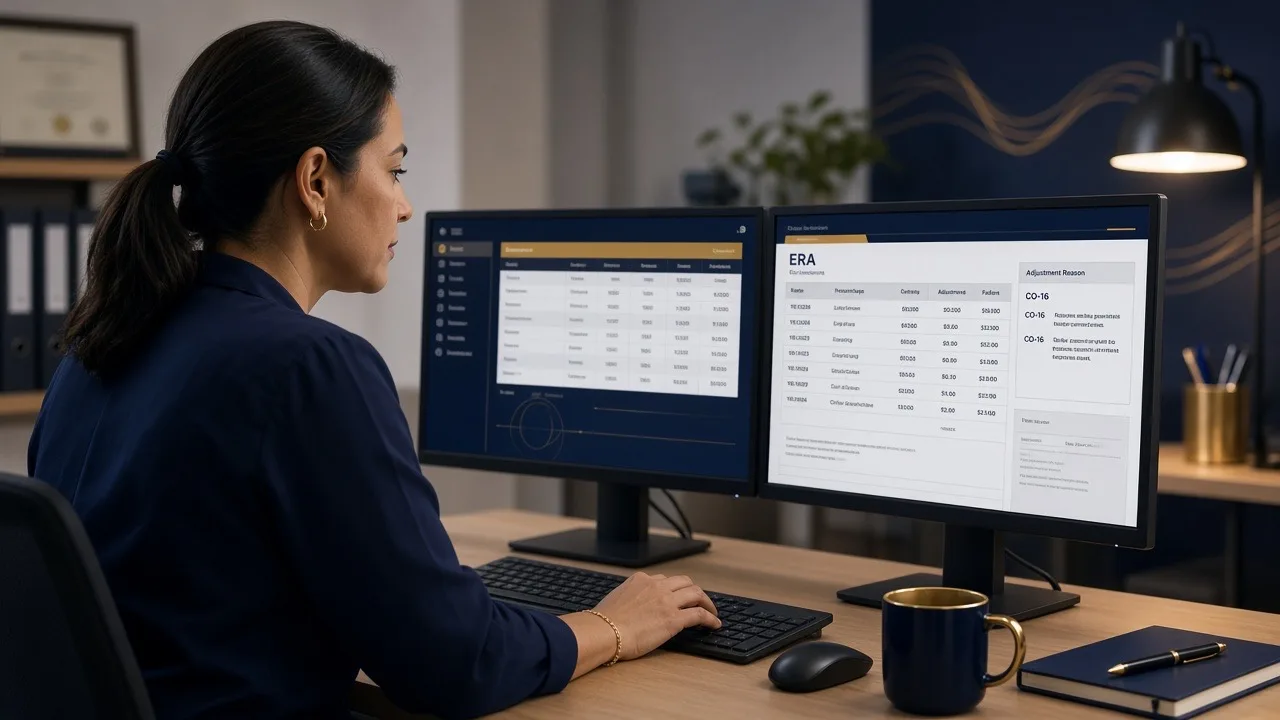
CO-45 is the most common adjustment on most ERAs, and most of the time it is correct. The problem is that underpaid claims look exactly the same.
Practice owners and billers search “CO-45 denial code” because it appears on almost every remittance and reduces every payment. Industry denial references for 2026 consistently list CO-45 alongside CO-16 and CO-97 as the highest-volume adjustment codes. Most teams post it and move on. That is right for most lines, but it is also how payers underpay without anyone noticing: there is no denial flag and no work queue entry.
This guide explains what CO-45 means, when to write it off, when to dispute it, and a simple check that finds underpayments hiding in your CO-45 adjustments.
Quick Answer
CO-45 = Charge exceeds fee schedule/maximum allowable or contracted/legislated fee arrangement.
- It is a pricing adjustment, not a coverage denial. The claim was usually paid or partly paid.
- With group code CO, the adjusted amount is a contractual write-off. Do not bill the patient for it.
- Write it off when the allowed amount matches your contracted rate for that CPT, modifier, place of service and date of service.
- Dispute it when the allowed amount is lower than your contract — for example, an outdated fee schedule, the wrong network product, or incorrect modifier pricing.
- Use the payer’s pricing reconsideration or payment dispute process, not a standard medical-necessity appeal.
Not sure your CO-45 write-offs are correct? Radiant RCM checks payments against your contracts as part of billing and payment posting. Book a free 30-minute demo or see Medical Billing Services.
Table of Contents
- What CO-45 Means
- CO-45 vs PR-45
- Write Off or Dispute? A Decision Guide
- Worked Example: Finding an Underpayment
- Common Causes of Incorrect CO-45 Adjustments
- How to Dispute an Underpaid CO-45
- How to Catch CO-45 Underpayments Every Month
- CO-45 Checklist
- FAQs
What CO-45 Means
CO-45 is a Claim Adjustment Reason Code (CARC) maintained by X12. Every payer uses the same definition: the billed charge was higher than the fee schedule, maximum allowable, or contracted or legislated amount, so the difference was adjusted off.
Most practices set their charge master above their highest payer rate, so CO-45 appears on nearly every paid line. That is expected. The payment you receive is the allowed amount minus any patient responsibility (deductible, coinsurance, copay), not your billed charge.
Key points:
- CO-45 by itself does not mean anything went wrong
- The number to check is the allowed amount, not the size of the adjustment
- A large CO-45 is normal when your charges are high; a wrong allowed amount is the real issue
Related reading: CARC codes and how to read an ERA/EOB.
CO-45 vs PR-45
X12 allows reason code 45 with group code CO or PR, depending on who is liable.
- CO-45: The provider absorbs the difference under the contract or legislated fee arrangement. Write it off; do not bill the patient.
- PR-45: The payer is assigning that amount to the patient. This is less common and usually tied to out-of-network or non-participating situations. Confirm plan rules, state law and the No Surprises Act before billing a patient balance.
For out-of-network claims covered by the No Surprises Act, payment disputes go through open negotiation and, if needed, the federal independent dispute resolution (IDR) process rather than a standard appeal.
Write Off or Dispute? A Decision Guide
- Allowed amount equals your contracted rate: Write off. The adjustment is correct.
- Allowed amount is below your contracted rate: Dispute. This is an underpayment.
- Payer applied last year’s fee schedule: Dispute with the current rate sheet or contract amendment.
- Claim priced as out-of-network although you are participating: Dispute and confirm enrollment and network status. Related: credentialing vs payer enrollment.
- Modifier or place of service priced incorrectly: If your claim was wrong, submit a corrected claim. If the claim was right and the payer priced it wrong, dispute.
- Allowed amount looks low but you have no rate on file: Request the fee schedule from the payer first. You cannot dispute what you cannot prove.
Worked Example: Finding an Underpayment
This is an illustrative example, not real patient or payer data.
- Billed charge for CPT 99214: $200.00
- Contracted allowed amount (your fee schedule): $118.00
- ERA allowed amount: $104.00
- ERA shows CO-45: $96.00
The correct CO-45 should have been $200.00 − $118.00 = $82.00. The payer adjusted $96.00, so the line is underpaid by $14.00.
$14 on one visit is easy to ignore. If the same rate error affects 300 visits a year with that payer, that is $4,200 in lost revenue from one code — and the ERA never flagged it as a problem.
This is why the check is “allowed amount vs contract,” not “is there a CO-45.”
Common Causes of Incorrect CO-45 Adjustments
1. Outdated fee schedule
The payer did not load a new year’s rates or a contract amendment. This is common in the first months of a new calendar or contract year.
2. Wrong network product or tier
The claim was priced under a different plan product (for example, a narrow network or Medicare Advantage product) than the one your contract covers.
3. Provider, TIN or NPI mismatch
A rendering provider who is not linked to the group contract can be priced at non-participating rates.
4. Modifier or place-of-service pricing
Professional-component, facility vs non-facility, or telehealth pricing applied incorrectly. Check your own claim first — if the POS or modifier was wrong, that is a corrected claim, not a dispute. Related: place of service codes.
5. Multiple-procedure reductions applied twice
Multiple-procedure reductions often appear under a different reason code (such as CARC 59). Make sure the same reduction was not also built into the allowed amount behind CO-45.
Want a second look at your payer payments? Our revenue cycle consulting includes payment and denial trend reviews for in-house billing teams.
How to Dispute an Underpaid CO-45
- Confirm the variance. Compare the ERA allowed amount with the contracted rate for the same CPT, modifier, POS and date of service.
- Rule out your own error. Check modifiers, POS, units and rendering provider on the submitted claim.
- Gather proof. Contract or fee schedule page, the 835/ERA line, and the exact dollar variance.
- Use the right channel. Payers call it a reconsideration, payment dispute or claim review. Your contract and provider manual name the route and deadline.
- Group repeat errors. If the same CPT is underpaid across many claims, raise it with provider relations as one systematic issue, not one claim at a time.
- Track the outcome. Confirm that later claims price correctly after the fix.
Related: underpayment recovery and how to appeal denied claims.
How to Catch CO-45 Underpayments Every Month
- Load contracted rates for your top payers and top 20–30 CPT codes into your billing system or a simple spreadsheet
- Compare ERA allowed amounts to those rates at the line level during payment posting
- Flag any line where allowed is below contract, then group by payer and CPT
- Re-check rates every January and whenever a contract amendment takes effect
- Keep credentialing and payer enrollment current so claims are not priced as non-participating
- Report contractual adjustments and underpayment recoveries alongside your net collection rate
Accurate payment posting is where this check belongs. If posting staff only key in totals, underpayments disappear into CO-45.
CO-45 Checklist
- Confirm the group code (CO or PR) before deciding who owes the balance
- Compare allowed amount, not adjustment size, with your contracted rate
- Write off only when allowed matches contract
- Correct and resubmit when your claim data caused the pricing error
- Dispute through the payer’s pricing channel when the payer priced it wrong
- Never balance-bill the patient for a CO-45 amount
- Track underpayments by payer and CPT and fix patterns, not single claims
Final Thoughts
CO-45 is normal, and most CO-45 adjustments are correct. Treat it as a routine write-off only after the allowed amount matches your contract. A short monthly comparison during payment posting is usually enough to find the underpayments that would otherwise be written off without anyone noticing.
If you want that check built into your billing workflow, Radiant RCM can help. Book a free 30-minute demo or read our medical billing FAQs.
Frequently Asked Questions
What does CO-45 mean in medical billing?
CO-45 means the billed charge exceeded the payer’s fee schedule, maximum allowable, or contracted or legislated amount. With the CO group code, the difference is a contractual write-off.
Is CO-45 a denial?
Usually not. It is a pricing adjustment on a paid or partly paid line. It only needs action when the allowed amount is lower than your contracted rate.
Can I bill the patient for a CO-45 adjustment?
No. CO means contractual obligation, so the provider absorbs the amount. Only PR (patient responsibility) amounts can be billed to the patient, subject to plan rules and state and federal law.
When should I appeal or dispute CO-45?
When the allowed amount does not match your contract, for example because an outdated fee schedule, wrong network product or incorrect modifier pricing was applied. Use the payer’s pricing dispute or reconsideration process.
What is the difference between CO-45 and PR-45?
Both use reason code 45. CO-45 assigns the amount to the provider as a write-off. PR-45 assigns it to the patient, which is less common and usually tied to out-of-network or non-participating claims.
How can I find underpayments hidden in CO-45?
Compare the ERA allowed amount for each line with your contracted rate for that CPT, modifier, place of service and date of service. Any line where allowed is below contract is a potential underpayment.
Sources
- X12 Claim Adjustment Reason Codes — official CARC 45 definition and group code usage
- CMS No Surprises Act — out-of-network payment disputes and federal IDR
Privacy Notice: Please do not submit patient records, insurance information, medical details, claim files, or other protected health information through the public website form. Review the Radiant RCM Privacy Policy before submitting an inquiry.
This article provides general operational information. Payer contracts, dispute deadlines and patient billing rules vary by payer and state. Confirm your contract terms and current payer policies before writing off or disputing adjustments.