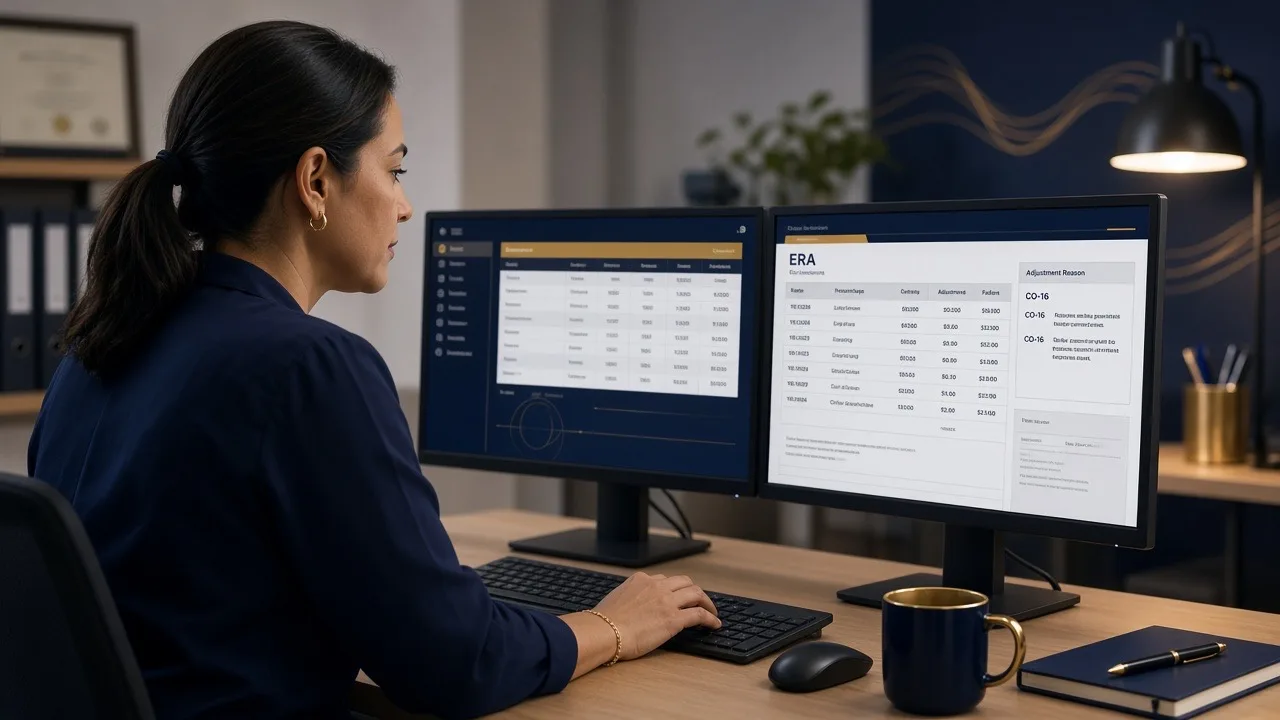
CO-16 is one of the most common denial codes in medical billing — and one of the most misunderstood. The code alone does not tell you what to fix.
Billers search “CO-16 denial code” because it shows up constantly on ERAs, yet the claim looks complete at first glance. CO-16 means the claim lacks information or has a submission/billing error. The real instruction is in the paired Remittance Advice Remark Code (RARC). Skip the RARC, and you guess, resubmit wrong, and burn another cycle.
This 2026 guide explains what CO-16 means, how to read the RARC, the most common fixes, and a resubmit workflow that gets these claims paid on the second pass.
Quick Answer
CO-16 = Claim/service lacks information or has submission/billing error(s). Group code CO means contractual obligation — do not bill the patient for it.
What to do:
- Open the 835 ERA/EOB and find every RARC paired with CO-16
- Fix only the field(s) the RARC names (NPI, auth, diagnosis pointer, member ID, etc.)
- Verify the corrected value against the source record and payer enrollment
- Resubmit as a corrected claim (frequency code 7 / replacement), not a brand-new original
- Do not treat every CO-16 as an appeal — most are data fixes
- Prevent the next one with claim scrubbing and eligibility checks before submission
CO-16 denials piling up? Radiant RCM can tighten scrubbing, eligibility, and denial workflows. Request a demo or see Medical Billing Services.
Table of Contents
- What CO-16 Means
- Why the RARC Matters More Than CO-16
- Most Common CO-16 Causes and Fixes
- How to Fix and Resubmit CO-16
- CO-16 vs Similar Denial Codes
- How to Prevent CO-16 Denials
- CO-16 Resolution Checklist
- When Support May Help
- FAQs
What CO-16 Means
On an ERA or EOB, CO-16 is a Claim Adjustment Reason Code (CARC). In plain language: the payer could not adjudicate the claim because required information is missing, incomplete, or invalid.
Important points:
- It is usually a data problem, not a coverage or medical-necessity decision
- The CO group code means provider write-off / contractual adjustment — do not balance-bill the patient for the CO-16 amount
- CO-16 by itself is a container code. The paired RARC names the field
Related reading: CARC codes, how to read an ERA/EOB, and claim rejection vs denial.
Why the RARC Matters More Than CO-16
Payers are expected to attach at least one Remittance Advice Remark Code with CARC 16. That remark is the actionable part.
Examples of what RARCs can point to:
- Rendering or referring provider NPI missing or invalid
- Member ID / Medicare Beneficiary Identifier (MBI) issues
- Diagnosis code, pointer, or CPT/HCPCS problems
- Missing authorization or referral number
- Incomplete demographics, accident detail, or other required claim loops
If your ERA viewer shows CO-16 with no remark, open the raw 835 in the clearinghouse or payer portal. Guessing the missing field is how teams create a second CO-16 on the same claim.
Most Common CO-16 Causes and Fixes
1. Provider identifiers (rendering / referring / ordering NPI)
Confirm the NPI against NPPES and the payer enrollment record. Fix the wrong loop (rendering vs referring) — they are not interchangeable.
2. Patient / member identifiers
Re-run eligibility. Update member ID, MBI, name spelling, DOB, and subscriber relationship to match the payer file — not the old card on file.
3. Authorization or referral missing
Add the exact auth/referral number the payer issued for that service date and CPT range. If auth was never obtained, fix the front-end process; a blank field will not create coverage.
4. Diagnosis and procedure data errors
Validate ICD-10 specificity for the date of service, CPT/HCPCS validity, and diagnosis pointers on each service line. Related: coding error reduction and medical necessity.
5. Modifier or place-of-service inconsistencies
Missing or invalid modifiers and wrong POS can surface under CO-16 or related codes like CO-4. Scrub before release. Related: modifier usage and place of service codes.
6. Taxonomy, taxonomy mismatch, or enrollment gaps
Some commercial and Medicare Advantage plans require taxonomy or specific billing/rendering combinations. Confirm credentialing and enrollment before blaming the claim form.
Need fewer missing-info denials? Book a Radiant RCM demo to tighten claim scrubbing and front-end edits.
How to Fix and Resubmit a CO-16 Denial
- Pull the remittance. Locate CO-16 and every paired RARC on that claim/line.
- Map RARC → field. Identify the exact claim element named by the remark.
- Verify at the source. Eligibility portal, enrollment file, order, auth letter, or chart — not memory.
- Correct every flagged field. Fix all RARCs on the claim, not only the first one.
- Resubmit as a corrected claim. Use frequency/type code 7 (replacement) and reference the original claim/ICN. Do not submit as a new original if the payer requires a replacement — that risks duplicate claim denials (often CO-18).
- Track turnaround. Log payer, RARC, root cause, and days to payment so the same error stops recurring.
Appeal only when the original data was correct and the payer applied the wrong requirement — with proof of the original submission and supporting documents. Most CO-16s are corrected claims, not formal appeals. Related: how to appeal denied claims.
CO-16 vs Similar Denial Codes
- CO-16: Missing/invalid claim data for adjudication — fix the field named by the RARC
- CO-4: Modifier inconsistent or missing relative to the procedure
- CO-18: Duplicate claim / service
- CO-29: Timely filing — often hard after the window; see timely filing limits
- CO-50 / CO-150: Medical necessity / not deemed necessary based on diagnosis
- CO-97: Bundled service — often NCCI; see NCCI edits
PR-group codes (patient responsibility) are a different story. Do not confuse a CO write-off pattern with a PR balance.
How to Prevent CO-16 Denials
- Verify eligibility close to the date of service (ideally 24–72 hours before)
- Run payer-specific claim scrubbing before release — see claim scrubbing
- Require rendering/referring NPIs and taxonomy when the payer edit demands them
- Capture auth numbers in the same workflow that schedules the service
- Validate ICD-10/CPT combinations and diagnosis pointers at coding
- Trend CO-16 by RARC and by payer monthly — then fix the top three root causes
Prevention is what lifts clean claim rate and first-pass resolution rate.
CO-16 Resolution Checklist
- Find CO-16 and every paired RARC on the ERA
- Map each RARC to a specific claim field
- Confirm corrected values at the source system of record
- Update the claim; do not change unrelated fields at random
- Resubmit as replacement/corrected (frequency 7) with original claim reference
- Confirm the claim is not re-filed as a duplicate original
- Log root cause and owner for process fix
- Add a scrubber rule if the same RARC repeats
When Outside Support May Help
Your practice may need help when:
- CO-16 is a top denial reason every month
- Staff resubmit without reading RARCs
- Second-pass denials keep coming after “fixes”
- Clearinghouse scrubbing rules are thin or outdated
- Denial A/R age is rising while first-pass metrics stay flat
Radiant RCM supports healthcare practices with medical billing, denial management, claim scrubbing, and revenue cycle consulting.
Sensitive patient and insurance information should only be shared through approved and secure channels. Learn more about Radiant RCM's HIPAA compliance and information-handling approach.
Final Thoughts
CO-16 is a missing-information container, not a diagnosis. Read the RARC, fix the named field, resubmit as a corrected claim, and harden front-end edits so the same error stops. That is how practices cut one of the highest-volume denial patterns in 2026.
If CO-16 is slowing cash flow, Radiant RCM can help. Request a demo to see how our denial and scrubbing workflows clear missing-info claims faster.
Frequently Asked Questions
What does CO-16 mean in medical billing?
CO-16 means the claim or service lacks information or has submission/billing errors. The CO group code indicates a contractual adjustment; read the paired RARC to see which field to fix.
Can I bill the patient for a CO-16 denial?
Usually no. CO adjustments are contractual/provider responsibility. Do not balance-bill the patient for a CO-16 write-off amount.
Should I appeal a CO-16 denial?
Most of the time, no. Correct the missing or invalid data and resubmit as a corrected claim. Appeal when the original data was correct and you have proof the payer applied the wrong requirement.
What is the difference between CO-16 and the RARC?
CO-16 is the broad denial category. The RARC is the specific remark that identifies the missing or invalid element (for example a provider NPI or member ID issue).
How do I resubmit a CO-16 claim correctly?
Fix the RARC-named fields, then submit a replacement/corrected claim (often frequency code 7) that references the original claim number. Avoid filing a brand-new original unless the payer instructs otherwise.
How can a billing partner reduce CO-16 denials?
Experienced teams trend CO-16 by RARC and payer, tighten scrubbing and eligibility, coach staff on corrected-claim workflow, and stop repeat missing-info errors before submission.
Privacy Notice: Please do not submit patient records, insurance information, medical details, claim files, or other protected health information through the public website form. Review the Radiant RCM Privacy Policy before submitting an inquiry.
This article provides general operational information. Payer edits, RARC usage, and corrected-claim rules vary and can change. Confirm current payer-specific requirements before changing denial workflows.