One wrong two-digit place of service code can cut reimbursement sharply — or stop the claim entirely. POS coding is one of the highest-leverage fields on a professional claim.
Place of service (POS) codes tell payers where care was rendered. They drive facility vs non-facility payment, telehealth adjudication, and many claim edits. Practices searching this topic are usually fixing underpayments, fighting CO-4 / CO-5 / CO-58 denials, or cleaning up telehealth POS 02 vs 10 mistakes — all high-intent revenue cycle problems.
This guide explains place of service codes in medical billing, the codes practices use most, how POS affects payment in 2026, and how to prevent recurring POS denials.
Quick Answer
Place of service codes are two-digit CMS codes reported on professional claims (CMS-1500 / 837P) to identify the setting where a service was provided.
A strong POS workflow should:
- Match POS to the actual service setting and ownership rules
- Use POS 11 for physician office (non-facility) when appropriate
- Use facility POS codes (21, 22, 23, 24, and related) when the setting is facility-based
- Separate telehealth POS 02 vs POS 10 by patient location and payer guidance
- Scrub CPT-to-POS conflicts before submission
- Reconcile paid amounts against expected facility vs non-facility rates
- Track POS denials by CARC and payer for prevention
POS is not a formatting detail. It is a payment and compliance decision.
Table of Contents
- What Place of Service Codes Are
- Most-Used POS Codes
- POS 11 vs POS 22 and Payment Impact
- Telehealth POS 02 vs 10
- POS Denials and How to Fix Them
- POS Accuracy Checklist
- When Support May Help
- FAQs
What Are Place of Service Codes in Medical Billing?
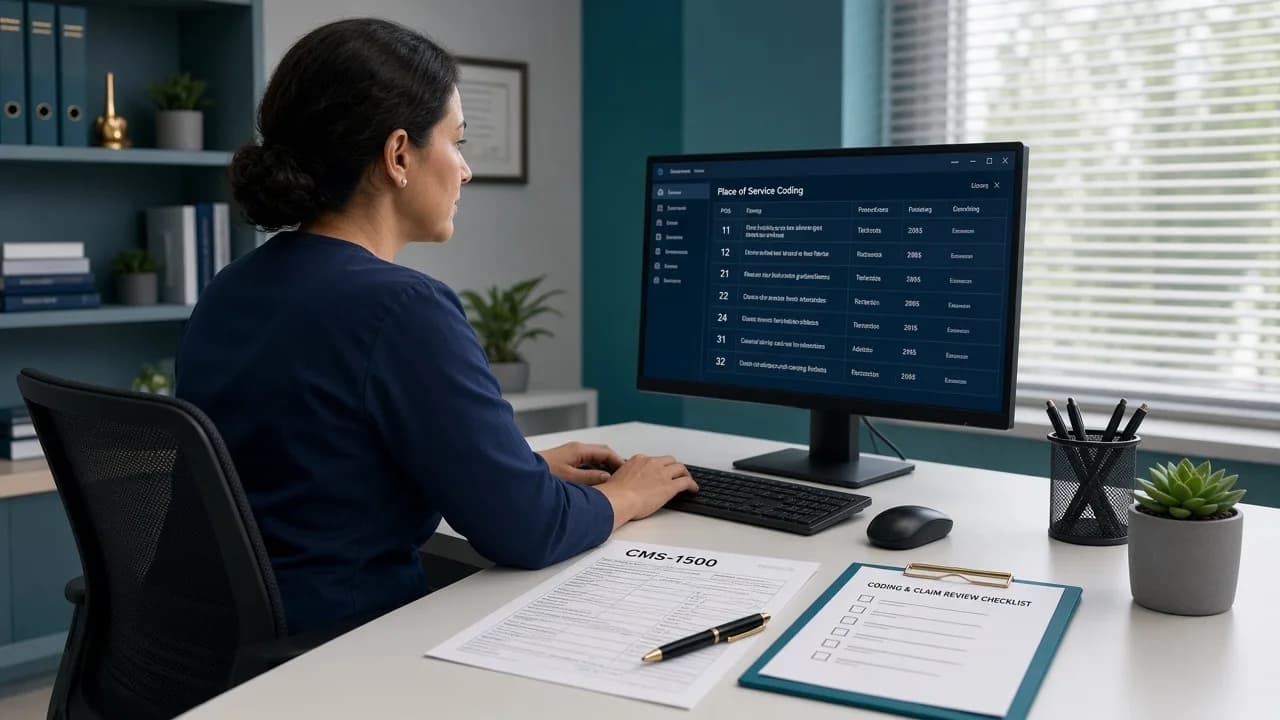
Place of service codes are maintained by CMS and required on professional claims to identify where the service was performed. On paper CMS-1500 claims they appear in Box 24B. On electronic 837P claims they map to the service-line place of service field.
Institutional claims (UB-04 / 837I) do not use POS the same way. They rely on Type of Bill, revenue codes, and related facility fields. Mixing claim-type rules is a common clearinghouse and training failure.
POS coding connects tightly to claim scrubbing, modifier usage, telehealth billing, underpayment recovery, and CARC denial reason codes.
Most-Used Place of Service Codes
Practices do not need every code memorized, but staff must know the high-volume ones cold:
- 11 — Office: Physician office / clinic; typically non-facility payment
- 12 — Home: Services in the patient’s residence
- 19 — Off Campus-Outpatient Hospital: Hospital outpatient, off campus
- 21 — Inpatient Hospital: Facility inpatient setting
- 22 — On Campus-Outpatient Hospital: Hospital outpatient on campus; facility payment
- 23 — Emergency Room — Hospital: Hospital ER
- 24 — Ambulatory Surgical Center: Freestanding ASC
- 31 — Skilled Nursing Facility: SNF setting
- 02 — Telehealth Provided Other than in Patient’s Home: Telehealth when patient is not at home
- 10 — Telehealth Provided in Patient’s Home: Telehealth when patient is at home
Always confirm current payer guidance. Commercial plans may diverge from Medicare on telehealth and site-of-service payment.
POS 11 vs POS 22: Why the Pay Gap Matters
Under the Medicare Physician Fee Schedule, many CPT codes carry different facility and non-facility rates. The POS code helps determine which rate applies.
- POS 11 (office) usually supports the higher non-facility rate because the practice bears overhead.
- POS 22 (on-campus outpatient hospital) usually supports the lower facility rate because the hospital bills facility overhead separately.
In 2026, facility vs non-facility differences remain a major cash and compliance issue:
- Billing a facility POS for a true office service can permanently underpay the practice
- Billing POS 11 for a facility-based service can create overpayment and audit exposure
- Hospital-owned clinics that “feel like” offices may still require a facility POS
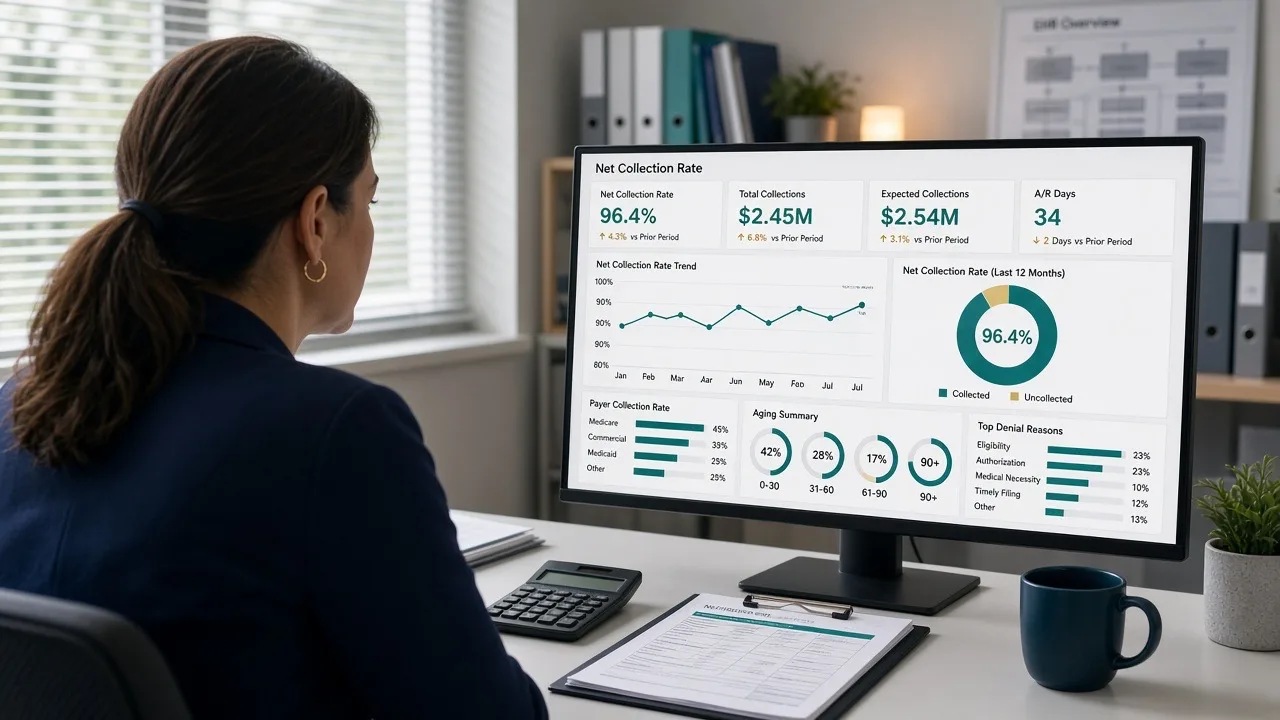
Best practice: decide POS by ownership and CMS setting definitions, not by how the room looks. Then reconcile ERAs against expected allowed amounts. Related: ERA/EOB reading and net collection rate.
Telehealth Place of Service: POS 02 vs POS 10
Telehealth POS mistakes are still one of the fastest ways to create denials or underpayments.
- POS 10: telehealth when the patient is in their home
- POS 02: telehealth when the patient is not in their home
Payment, modifier expectations, and coverage can differ by payer and date of service. Build a payer matrix rather than one universal telehealth rule. Pair POS with the correct modality documentation and any required modifiers. See the full telehealth billing guide.
Common POS Denials and How to Fix Them
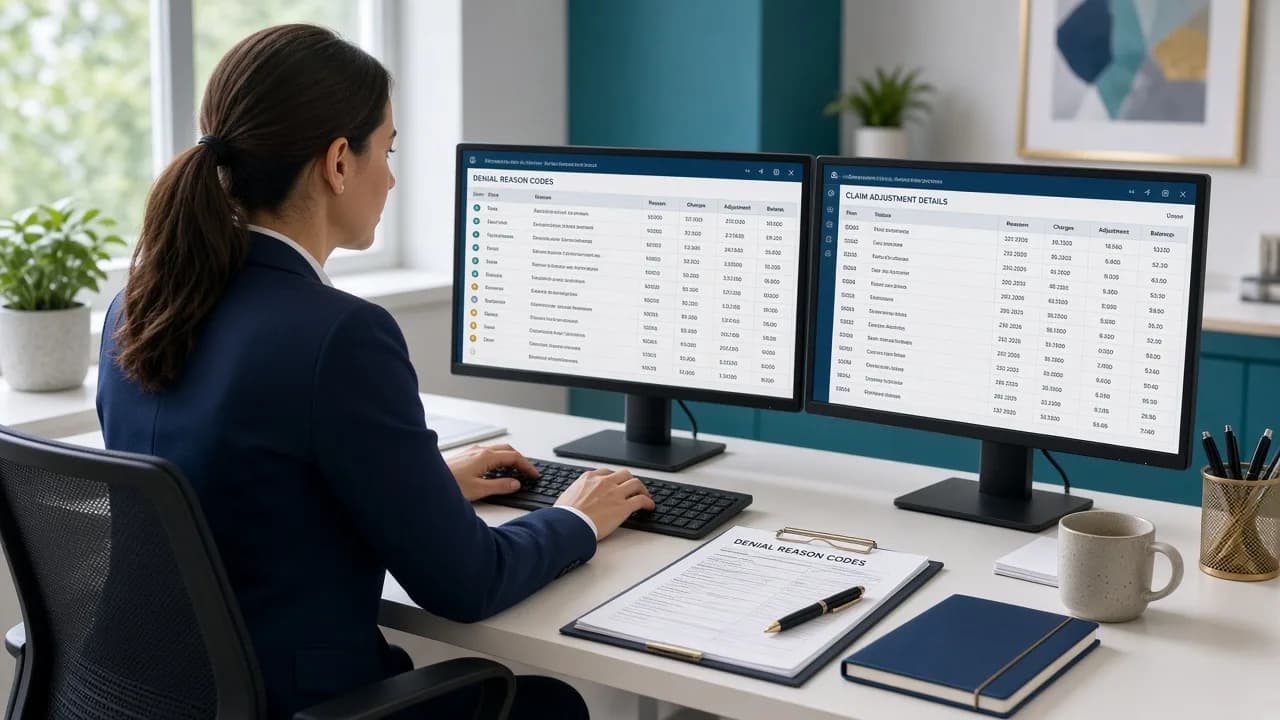
CARC 5 — Procedure Inconsistent With Place of Service
The CPT and POS combination fails payer edits. Correct the setting or the procedure coding, then resubmit as a corrected claim when required.
CARC 58 — Inappropriate or Invalid Place of Service
The payer judged the setting invalid for the service. Review documentation, setting ownership, and payer policy before appealing or correcting.
CARC 4 — Modifier / Procedure Inconsistency
Modifiers and POS often collide on telehealth and site-of-service claims. Validate modifier-to-POS compatibility in scrubbing.
CARC 16 — Missing or Invalid Information
Blank, invalid, or undocumented POS can trigger information denials. Read the paired RARC. See CARC codes.
Silent Underpayment Without a Hard Denial
Some claims pay — just at the wrong rate. That will not always look like a denial in A/R. Compare expected facility/non-facility allowed amounts during posting.
Radiant RCM's Medical Billing Services, claim scrubbing support, and Revenue Cycle Consulting help practices stop POS leakage before it ages into write-offs.
Place of Service Accuracy Checklist
- Confirm where the service actually occurred
- Confirm whether the setting is office, hospital outpatient, ASC, ER, home, or telehealth
- Apply POS by ownership and CMS definitions, not assumptions
- For telehealth, confirm patient location (home vs not home) and payer POS rules
- Scrub CPT + modifier + POS combinations before submission
- Review clearinghouse rejects tied to POS the same day
- Reconcile paid amounts to expected facility vs non-facility rates
- Track CO-4, CO-5, CO-16, and CO-58 denials by POS pattern
- Update templates for hospital clinics, ASC days, and telehealth schedules
- Train schedulers and billers on the same POS matrix
This checklist pairs well with clean claim rate and denial management workflows.
When Outside Support May Help
Your practice may need help when:
- POS denials keep recurring across the same clinics or ASC days
- Telehealth claims swing between POS 02 and POS 10 without a payer matrix
- Paid claims look “complete” but fall short of expected non-facility rates
- Hospital-employed or hybrid clinics create ownership confusion for billers
- Staff cannot explain facility vs non-facility payment differences
- Leadership wants POS analytics tied to underpayments and denials
Radiant RCM supports healthcare practices with medical billing, claim scrubbing, denial prevention, underpayment recovery, and revenue cycle consulting.
Sensitive patient and insurance information should only be shared through approved and secure channels. Learn more about Radiant RCM's HIPAA compliance and information-handling approach.
Final Thoughts
Place of service codes decide setting, payment pathway, and many edit outcomes. Get POS 11 vs 22 right. Separate telehealth POS 02 vs 10 by patient location and payer rules. Scrub conflicts before submission and reconcile rates after payment.
Practices that treat POS as a revenue control — not a defaulted dropdown — protect both cash flow and compliance.
If POS coding errors are cutting reimbursement or stacking denials, Radiant RCM can help. Request a demo to see how our billing workflows keep site-of-service coding accurate from charge capture to payment.
Frequently Asked Questions
What are place of service codes in medical billing?
Place of service codes are two-digit CMS codes on professional claims that identify where a service was provided. They affect reimbursement, coverage decisions, and claim edits.
Where is the place of service code entered on a claim?
On the CMS-1500, POS is reported in Box 24B for each service line. On the electronic 837P, it is reported in the corresponding service-line place of service field.
What is the difference between POS 11 and POS 22?
POS 11 is typically physician office and supports non-facility payment. POS 22 is on-campus hospital outpatient and usually supports lower facility payment because facility overhead is billed separately.
What is the difference between telehealth POS 02 and POS 10?
POS 10 is used when telehealth is provided with the patient in their home. POS 02 is used when telehealth is provided with the patient not in their home. Confirm payer-specific rules before billing.
Which denial codes are commonly tied to POS errors?
Common remittance reasons include procedure-to-POS conflicts, invalid place of service, modifier inconsistencies, and missing/invalid information denials such as those often seen with CARC 4, 5, 16, and 58.
Can a billing partner reduce POS-related revenue loss?
Yes. Experienced teams can tighten POS matrices, scrubbing edits, telehealth rules, and underpayment checks so site-of-service mistakes stop repeating.
Privacy Notice: Please do not submit patient records, insurance information, medical details, claim files, or other protected health information through the public website form. Review the Radiant RCM Privacy Policy before submitting an inquiry.
This article provides general operational information. Place of service definitions and payer payment policies can change. Confirm current CMS POS code set text and payer-specific site-of-service rules before changing billing workflows.