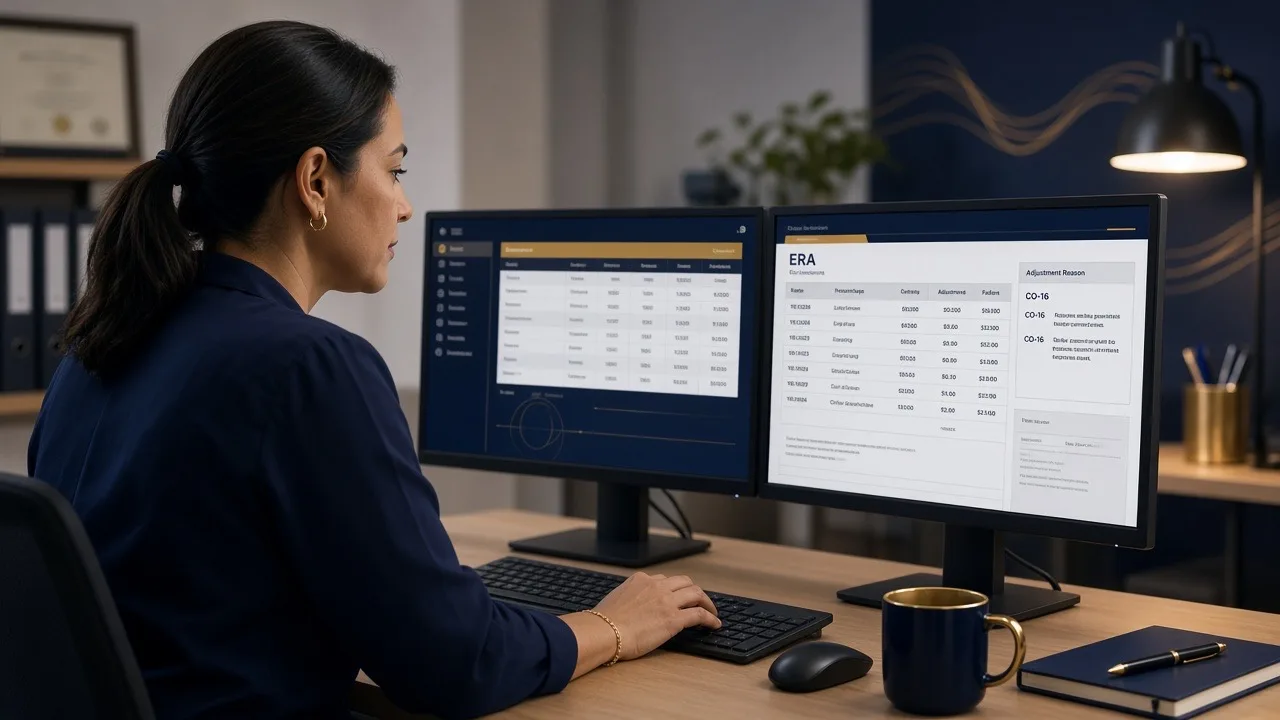
CO-97 is the bundling denial. One service was paid (or is payable) as part of another — and the second line will not pay separately unless the edit and documentation allow it.
Billers search “CO-97 denial code” because it is one of the highest-volume adjustments after missing-information denials. It often ties to NCCI Procedure-to-Procedure (PTP) edits, payer-specific bundles, or wrong use of modifier 59 / X modifiers. Guessing a modifier without checking the edit indicator creates compliance risk and repeat denials.
This 2026 guide explains what CO-97 means, how to verify the bundling rule, when a modifier can override it, and how to stop the next CO-97 before submission.
Quick Answer
CO-97 = The benefit for this service is included in the payment/allowance for another service/procedure already adjudicated (or on the same claim).
What to do:
- Read the ERA line and any RARC — confirm it is true bundling, not a miscoded CO-16/CO-4
- Check the NCCI PTP pair (or payer edit) for the date of service
- If the modifier indicator is 0, no NCCI-associated modifier can bypass a correctly applied edit — usually accept or appeal only if the wrong edit was applied
- If the indicator is 1 and services were truly distinct, append the most specific allowed modifier (prefer XE/XS/XP/XU over 59 when they fit)
- Document site, session, and clinical distinctness — modifiers alone are not proof
- Do not bill the patient for a CO contractual bundling write-off
CO-97 bundling denials stacking up? Radiant RCM can tighten NCCI scrubbing and modifier workflows. Request a demo or see Medical Billing Services.
Table of Contents
- What CO-97 Means
- NCCI PTP Edits and Modifier Indicators
- When a Modifier Can Fix CO-97
- Common Causes of CO-97
- How to Fix or Close a CO-97 Denial
- CO-97 vs Similar Codes
- How to Prevent CO-97 Denials
- CO-97 Checklist
- When Support May Help
- FAQs
What CO-97 Means
On an ERA/EOB, CO-97 is a Claim Adjustment Reason Code (CARC). In plain language: payment for this service is considered included in another service already paid or allowed.
Key points:
- Group code CO = contractual obligation — typically a provider write-off, not patient balance
- CO-97 is not automatically “wrong coding.” Many bundles are correct and final
- The fix path depends on why it bundled: NCCI PTP, MUE/frequency, global package, or commercial payer policy
Related reading: CARC codes, NCCI edits, and how to read an ERA/EOB.
NCCI PTP Edits and Modifier Indicators
For Medicare (and many payers that mirror NCCI), Procedure-to-Procedure edits pair a Column One (comprehensive) code with a Column Two (component) code.
- Modifier indicator 0: An NCCI-associated modifier cannot bypass the edit. Separately billing the Column Two code is not payable when the edit applies correctly.
- Modifier indicator 1: An NCCI-associated modifier may bypass the edit when the services were distinct and documentation supports it.
Always check the edit table effective for the date of service, not last quarter’s spreadsheet sitting on a desktop.
CMS treats modifier 59 as a last-resort distinct-procedure tool. Prefer a more specific X modifier when it fits. Related: modifier 25 vs 59 and modifier usage.
When a Modifier Can Fix CO-97
A modifier is appropriate only when all of these are true:
- The applicable edit allows a modifier (indicator 1), or the payer’s policy allows one
- The services were clinically / anatomically / temporally distinct
- The note supports that distinctness (separate site, encounter, practitioner, or non-overlapping work)
- You chose the most specific modifier (XE, XS, XP, XU, or anatomic/laterality when required) instead of defaulting to 59
Putting 59 on every Column Two code is an audit pattern, not a revenue strategy.
Common Causes of CO-97 Denials
1. True NCCI component billing
Column Two was billed with Column One without a valid override. If indicator 0 applies, the denial should stand.
2. Distinct services without a supporting modifier
Indicator 1 pair, services were distinct, but no (or wrong) modifier was on the correct line.
3. Overuse of modifier 59
59 used when XS/XE/XP/XU or RT/LT fits better — payers may still deny or flag for review.
4. Global surgical package overlap
Post-op care or related services fall inside the global period. Different modifiers apply (24, 58, 78, 79) — not a blind 59. Related: global surgical package.
5. Same-day E/M + procedure confusion
E/M issues usually involve modifier 25, not CO-97 unbundling of two procedures — but teams mix the paths. Confirm whether the denied line is an E/M or a procedure.
Need cleaner same-day claims? Book a Radiant RCM demo to scrub NCCI pairs before payers bundle them.
How to Fix or Close a CO-97 Denial
- Confirm the denial. Pull the 835. Note CPT pair, paid line, denied line, and any RARC.
- Identify the rule. NCCI PTP, payer policy, MUE, or global package?
- Check the modifier indicator (for NCCI) for that DOS.
- If indicator 0 and the edit is correct: write off; do not keep resubmitting with 59.
- If indicator 1 and distinctness is documented: correct the claim with the proper modifier on the appropriate line; resubmit as a corrected claim if required.
- If the wrong edit/context was applied: request reprocessing or appeal with the code-pair evidence and note.
- Log the root cause (missing scrubber rule, coder habit, missing documentation) so it does not recur.
Related: appealing denied claims, claim scrubbing, and CO-16 denial code.
CO-97 vs Similar Denial Codes
- CO-97: Service included in another service/procedure allowance
- CO-16: Missing/invalid claim information — fix the RARC-named field
- CO-4: Modifier inconsistent with procedure or missing required modifier
- CO-18: Duplicate claim/service
- CO-50 / CO-150: Medical necessity / not deemed necessary
Do not treat every CO-97 like a CO-16 “just add data” fix. Bundling has different rules.
How to Prevent CO-97 Denials
- Run current NCCI PTP edits in the scrubber before release
- Train coders on indicator 0 vs 1 — and when to stop chasing payment
- Prefer X modifiers and anatomic modifiers over blanket 59
- Require documentation language for distinct services before modifier release
- Trend CO-97 by CPT pair and payer monthly
- Align surgical billing with global package rules
Prevention lifts clean claim rate and first-pass resolution rate.
CO-97 Resolution Checklist
- Identify paid vs denied CPT on the remittance
- Confirm bundling rule (NCCI vs payer vs global)
- Check modifier indicator for the DOS
- Decide: write-off, corrected claim with modifier, or appeal/reprocess
- If modifying, use the most specific allowed modifier
- Attach or retain documentation of distinctness
- Do not balance-bill the patient for CO-97
- Add a scrubber rule for repeat pairs
When Outside Support May Help
Your practice may need help when:
- CO-97 is a top denial every month
- Staff append 59 to every bundled pair
- NCCI tables are not in the claim scrubber
- Appeals overturn rates are low despite high modifier use
- Audit letters mention unbundling
Radiant RCM supports healthcare practices with medical billing, coding review, denial prevention, and revenue cycle consulting.
Sensitive patient and insurance information should only be shared through approved and secure channels. Learn more about Radiant RCM's HIPAA compliance and information-handling approach.
Final Thoughts
CO-97 is a bundling signal, not a blank check to add modifier 59. Verify the edit, respect indicator 0, use specific modifiers only when distinctness is real, and scrub NCCI pairs before claims leave. That is how practices cut one of the most expensive denial patterns in 2026.
If CO-97 is draining revenue, Radiant RCM can help. Request a demo to see how our coding and scrubbing workflows stop avoidable bundling write-offs.
Frequently Asked Questions
What does CO-97 mean in medical billing?
CO-97 means the payer included payment for the service in another service or procedure already allowed. It is a bundling/contractual adjustment, not a patient-responsibility balance.
Can modifier 59 always fix a CO-97 denial?
No. If the NCCI modifier indicator is 0, or the services are not distinct, 59 will not make the line payable and can create compliance risk. Prefer XE/XS/XP/XU when they fit and the edit allows a modifier.
What is the difference between CO-97 and CO-16?
CO-16 is missing or invalid claim information (fix the RARC-named field). CO-97 is bundling — payment is considered included in another service.
Should I appeal every CO-97?
No. Appeal or reprocess when the wrong edit/context was applied or distinct services were correctly documented with an allowed modifier. Accept write-offs when indicator 0 correctly applies.
Can I bill the patient for CO-97?
Usually no. CO group adjustments are contractual/provider responsibility. Do not balance-bill the patient for a CO-97 bundling write-off.
How can a billing partner reduce CO-97 denials?
Experienced teams scrub NCCI pairs, coach documentation for distinct services, stop default 59 habits, and trend bundling denials by CPT pair and payer.
Privacy Notice: Please do not submit patient records, insurance information, medical details, claim files, or other protected health information through the public website form. Review the Radiant RCM Privacy Policy before submitting an inquiry.
This article provides general operational information. NCCI edits, payer bundling rules, and modifier policies vary and can change. Confirm current CMS NCCI tables and payer-specific policies before changing coding workflows.