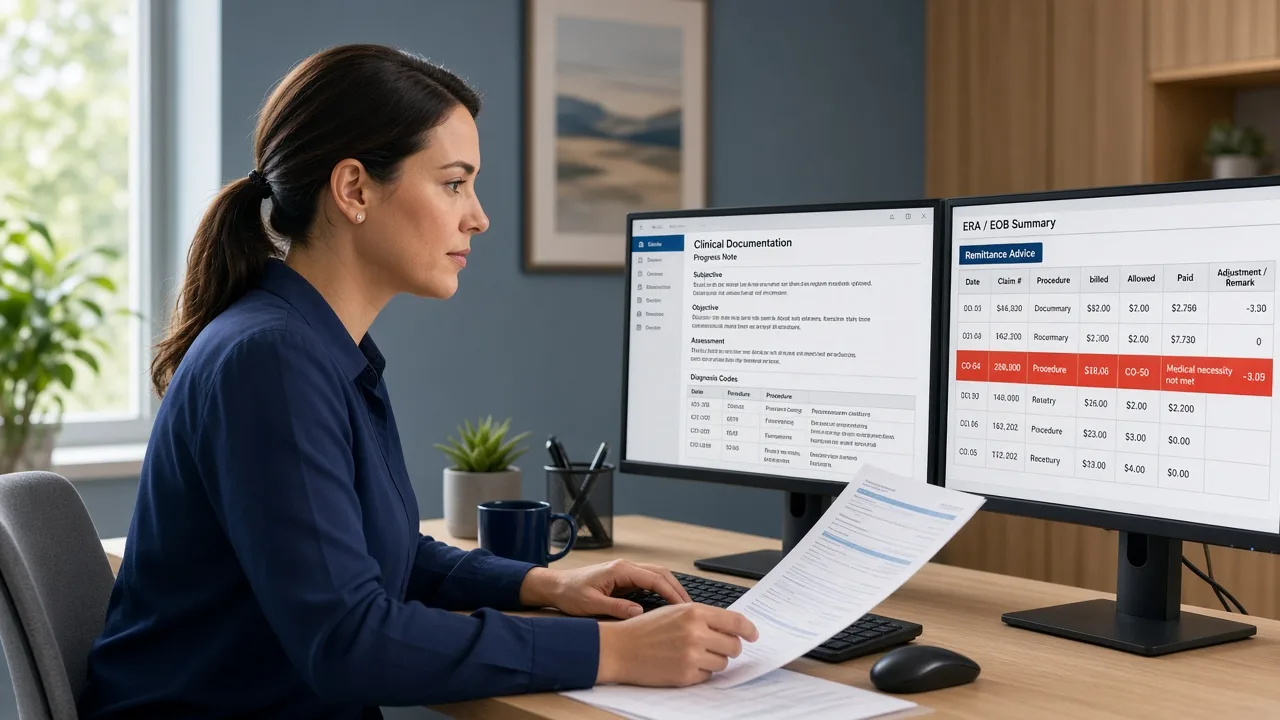
CO-96 is the denial that says the benefit itself is not there — not that the note was weak, and not that the claim was missing a field.
Billers search “CO-96 denial code,” “non-covered charge,” and “can I bill the patient for CO-96” because the remittance looks final. Sometimes it is. Sometimes a covered service was coded like an excluded one, sent to the wrong plan, or billed without the modifier that tells Medicare the line is statutorily excluded. With group code CO, the write-off usually stays with the practice. With PR-96, the balance can move to the patient when the plan and any required notice allow it.
This guide shows how to read CO-96, how it differs from a medical-necessity denial (CO-50), what N425 and N130 are telling you, and the four paths that fit: correct a coding error, bill the patient only when PR and the contract allow it, appeal a covered service that was misclassified, or write it off.
Quick Answer
- CO-96 = non-covered charge (CARC 96 with group code CO). X12 requires at least one remark code with it.
- It is not a medical-necessity denial (CO-50), not a fee-schedule cut (CO-45), and not a bundling edit (CO-97).
- Do not bill the patient for a CO-96 amount as a routine step. CO assigns the adjustment to the provider unless the contract and a valid notice say otherwise.
- PR-96 means the same reason — non-covered — with patient responsibility. On Original Medicare, a statutorily excluded service billed with modifier GY commonly returns PR-96 and remark N425.
- Do not use GY to turn a medical-necessity problem into a non-covered denial. Medical necessity uses GA, GZ, and the ABN path, and it lands on CARC 50, not 96.
- Read the remark first. N425 points to a statutory exclusion. N130 points you to the plan’s benefit limits. A wrong CPT can look “non-covered” when the service was covered.
- A true exclusion does not get fixed with a clinical appeal letter. A miscoded covered service does.
Non-covered write-offs hitting the same services? Radiant RCM checks benefits before the claim goes out. Book a free 30-minute demo or see Medical Billing Services.
Table of Contents
- What CO-96 Means
- CO-96 vs PR-96
- CO-96 vs CO-50, CO-204, and CO-27
- What the Remark Code Is Saying
- Medicare: GY, GX, and the ABN Line
- Which Path to Use
- Worked Example
- Why CO-96 Hits
- What Not to Do
- How to Stop the Next CO-96
- CO-96 Checklist
- FAQs
What CO-96 Means
X12 defines reason code 96 as: non-covered charge(s). The usage note says at least one remark code must be provided, and it points you to the 835 Healthcare Policy Identification Segment (loop 2110) when that reference is present. On a remittance, CO-96 means the payer did not treat this line as a covered benefit. The chart can be perfect. Payment still stops because the plan, the statute, or the code as billed sits outside coverage.
“Non-covered” is broader than one story:
- The service is excluded by law, such as many routine hearing, dental, or cosmetic services under Original Medicare
- The patient’s plan document excludes the category, even when another plan would pay it
- The CPT, HCPCS, modifier, or diagnosis on the claim describes a non-covered item, even if the visit was something else
- A benefit limit in the plan documents has already closed this service
Staff who treat every 96 as “appeal the notes” burn the deadline on lines that were never a coverage fight. Staff who write off every 96 leave covered services on the table when the code was simply wrong.
CO-96 vs PR-96
CARC 96 is the reason. The group code decides who carries the balance:
- CO-96 — contractual obligation. Usually a provider write-off. Do not move it to the patient without plan language and any required notice.
- PR-96 — patient responsibility. The payer is saying the patient can be billed for this non-covered charge. Still confirm the contract, state rules, and any notice you were required to give before the service.
- OA-96 / PI-96 — other or payer-initiated. Read the remark and the payer note before you choose write-off, patient billing, or appeal.
A workqueue that only stores “96” will bill the wrong person. Log CO versus PR on every line.
CO-96 vs CO-50, CO-204, and CO-27
- CO-96 — the charge is not a covered benefit as billed. The fight, if there is one, is “this service is covered” or “this code is wrong,” not “the note proves necessity.”
- CO-50 — the service can be covered, but the payer says it was not medically necessary for this patient. That uses the LCD, NCD, or commercial medical policy, and often an ABN. See CO-50 and medical necessity.
- CARC 204 — this service, equipment, or drug is not covered under the patient’s current benefit plan. More specific than 96. Same practical question: exclusion versus a coding or payer error.
- CO-27 — expenses incurred after coverage terminated. The benefit may exist. The policy did not, on that date of service. That is an eligibility problem. See eligibility verification.
- CO-16 — missing or invalid claim information. Fix the field. Do not treat it as a benefit exclusion. See CO-16.
What the Remark Code Is Saying
CARC 96 without the remark is only half a sentence. Two remarks show up often:
- N425 — statutorily excluded service(s). Medicare uses this when the item is outside the benefit by statute. Noridian pairs reason code 96 with N425 for that finding. A clinical appeal does not create a benefit Congress did not cover.
- N130 — consult the plan benefit documents for restrictions on this service. Pull the Summary of Benefits, Evidence of Coverage, or payer medical policy for that date of service before you decide the line is dead.
Other remarks can point to a missing modifier, a diagnosis the policy will not pair, or a frequency limit. Those are sometimes reopenable. A statutory exclusion usually is not.
Medicare: GY, GX, and the ABN Line
Original Medicare sorts “we will not pay” into two different denials. Mixing them up is how practices take write-offs they did not owe, or bill patients they cannot bill.
- GY — the item or service is statutorily excluded, or it does not meet the definition of a Medicare benefit. The line is submitted as non-covered. Contractors commonly deny it PR-96 with N425. The patient is liable. An ABN is not required for a true statutory exclusion, though a voluntary notice can set expectations.
- GX — a voluntary notice was issued for a statutory exclusion. It may be reported with GY. Liability stays with the beneficiary.
- GA — a required ABN is on file because you expect a denial as not reasonable and necessary. That is a medical-necessity path, not a GY path.
- GZ — you expect a medical-necessity denial and no valid ABN was issued. Medicare denies those lines as provider-liable, typically CO-50, not as a statutory PR-96.
Using GY on a service that Medicare covers when criteria are met tells Medicare the benefit does not exist. Using GZ on a service Medicare never covers accepts a write-off the practice may not have owed. Modifier choice is covered more broadly in modifier usage.
Which Path to Use
- The CPT, modifier, or diagnosis is wrong, and the service is covered: correct or reopen under that payer’s rules. Noridian’s guidance for 96 with N425 tells billers to reopen when a required modifier or diagnosis was left off.
- The service is statutorily excluded (Medicare): stop the clinical appeal. If the patient should be liable, bill with GY (and GX when you issued a voluntary notice) so the denial can land as PR-96. If you already have CO-96 because GY was missing, follow the contractor’s reopening instructions rather than resubmitting blindly.
- The commercial plan excludes the benefit, and the group code is PR: bill the patient only after you match the exclusion in the plan documents and any signed financial notice your contract requires.
- The group code is CO, and no notice shifts liability: write off. Do not hold the balance in patient AR while you “research.”
- You can show the service is a covered benefit and was coded correctly: appeal with the benefit language, not a stack of progress notes that never mention coverage. Use how to appeal denied claims for the packet, then aim it at the exclusion the remark named.
Worked Example
Made-up numbers, not a real patient or payer.
- Office bills a cosmetic procedure to Original Medicare with no GY modifier
- Remittance returns CO-96 and remark N425 for the full charge
- Staff drafts an appeal that attaches the operative note
The note does not create coverage. N425 says the service is statutorily excluded. The appeal path is the wrong tool. The billing path is GY so Medicare can deny it as patient responsibility (PR-96), plus a clear financial conversation before the service next time. If the contract or the setting forbids balance billing, the CO amount is a write-off and the front desk should have said so before the visit.
Change one fact: the clinician performed a covered lesion removal, and coding picked a cosmetic CPT by habit. Then CO-96 is a coding error. Reopen with the covered code and the diagnosis that supports it. Do not add GY to a covered service to “make the denial make sense.”
Why CO-96 Hits
The plan never covered the category
Hearing aids, routine dental, cosmetic services, and some supplies are common Medicare exclusions. Commercial plans add their own: infertility, weight-loss drugs, out-of-network brands. Eligibility can say “active” and still exclude the service. Check the benefit, not only the member ID. See eligibility verification.
A covered service was coded as an excluded one
The visit was payable. The CPT or the missing modifier described something the payer will not pay. Claim scrubbing should flag non-covered CPT patterns before submission. See claim scrubbing.
GY and GZ were swapped
GY on a medical-necessity case, or no modifier on a statutory exclusion, produces the wrong group code. The practice then either writes off a patient-liable line or bills a patient for a CO amount.
The claim went to a plan that does not have the benefit
Medicare Advantage, Medicaid, and commercial products do not share one exclusion list. A service Original Medicare excludes may be an extra benefit on an MA plan, or the reverse. Route the claim to the plan that actually covers it before you accept 96 as final.
What Not to Do
- Do not appeal N425 with the chart alone
- Do not bill the patient for a CO-96 amount by default
- Do not add GY to force a patient bill on a service Medicare can cover
- Do not treat CO-96 like CO-50 and skip the benefit document
- Do not resubmit the same excluded line every week
How to Stop the Next CO-96
- Keep a short exclusion list for your top payers and the services you actually perform
- Ask “is this benefit covered?” at scheduling, not only “is the member active?”
- Separate statutory exclusions (GY / PR-96) from medical-necessity risk (GA, GZ, ABN, CO-50)
- Scrub non-covered CPT and modifier pairs before the first submission
- Post CO versus PR correctly so patient statements do not include contractual write-offs
- Review CO-96 dollars monthly by CPT and payer in your denial management report
If non-covered write-offs are already in last month’s totals, the free Money Leak Check shows whether that leak is large enough to matter.
CO-96 Checklist
- Confirm CARC 96 and the group code (CO vs PR)
- Read the remark code and any loop 2110 policy reference
- Decide: statutory exclusion, plan exclusion, or a code that only looks excluded
- If the code is wrong, reopen or correct. Do not appeal
- If Medicare and the service is statutorily excluded, use GY rather than a necessity appeal
- If the group code is CO, do not bill the patient unless a valid notice and the contract allow it
- If the group code is PR, match the exclusion in the benefit document before you statement the patient
- Log the root cause so the same CPT does not repeat next month
Final Thoughts
CO-96 is a benefit denial. The remark tells you whether the benefit was never there or the claim described the wrong service. Correct the code when the service is covered. Use GY when Medicare excludes it by statute and the patient is liable. Write off CO amounts you cannot bill. A clinical appeal fixes neither a statutory exclusion nor a bad CPT.
If the same non-covered lines keep posting to the same payers, Radiant RCM can help. Request a free 30-minute demo or read the medical billing FAQs.
Frequently Asked Questions
What does CO-96 mean in medical billing?
CO-96 means the payer determined the charge is not covered. With the CO group code, the adjustment is usually the provider’s responsibility. At least one remark code must accompany CARC 96 and explain the exclusion or restriction.
Can I bill the patient for a CO-96 denial?
Do not bill the patient for a CO-96 amount as a routine step. CO is a contractual adjustment. Bill the patient when the remittance shows PR-96, the plan documents exclude the service, and any required notice was completed. On Original Medicare, statutorily excluded services are commonly billed with modifier GY so the denial can return as PR-96.
How is CO-96 different from CO-50?
CO-96 says the charge is not a covered benefit. CO-50 says the service was not medically necessary. Medical-necessity denials use the ABN and modifiers GA or GZ. Statutory exclusions use GY and land on CARC 96. Do not use GY to reclassify a medical-necessity denial.
What does remark code N425 mean with CO-96?
N425 means the service is statutorily excluded. Medicare contractors pair it with reason code 96 when the item is outside the Medicare benefit. A clinical appeal does not create coverage. If the patient is responsible, the line is usually billed with modifier GY so the group code can be PR.
Can I appeal a CO-96 denial?
Appeal when you can show the service is a covered benefit and was coded correctly, or reopen when a missing modifier or diagnosis made a covered service look non-covered. Do not appeal a true statutory exclusion with the medical record alone.
How do I prevent CO-96 denials?
Check plan benefits for the specific service before the visit, keep payer exclusion lists for the services you perform, separate GY exclusions from medical-necessity ABNs, and scrub non-covered code pairs before submission.
Sources
- X12 Claim Adjustment Reason Codes — official definition for reason code 96, including the required remark code
- Noridian reason code 96 and remark N425 — statutory exclusion and when a reopening applies
- Noridian noncovered charges and modifiers — GY, GZ, and who is liable
- Radiant RCM CO-50 guide — medical-necessity denials, ABNs, and GA/GZ
Privacy Notice: Please do not submit patient records, insurance information, medical details, claim files, or other protected health information through the public website form. Review the Radiant RCM Privacy Policy before submitting an inquiry.
This article provides general operational information. Coverage exclusions, patient billing rights, and modifier rules vary by payer, plan, state, and Medicare contractor. Confirm the current benefit document or contractor manual before you correct, appeal, bill a patient, or write off a CO-96 denial.