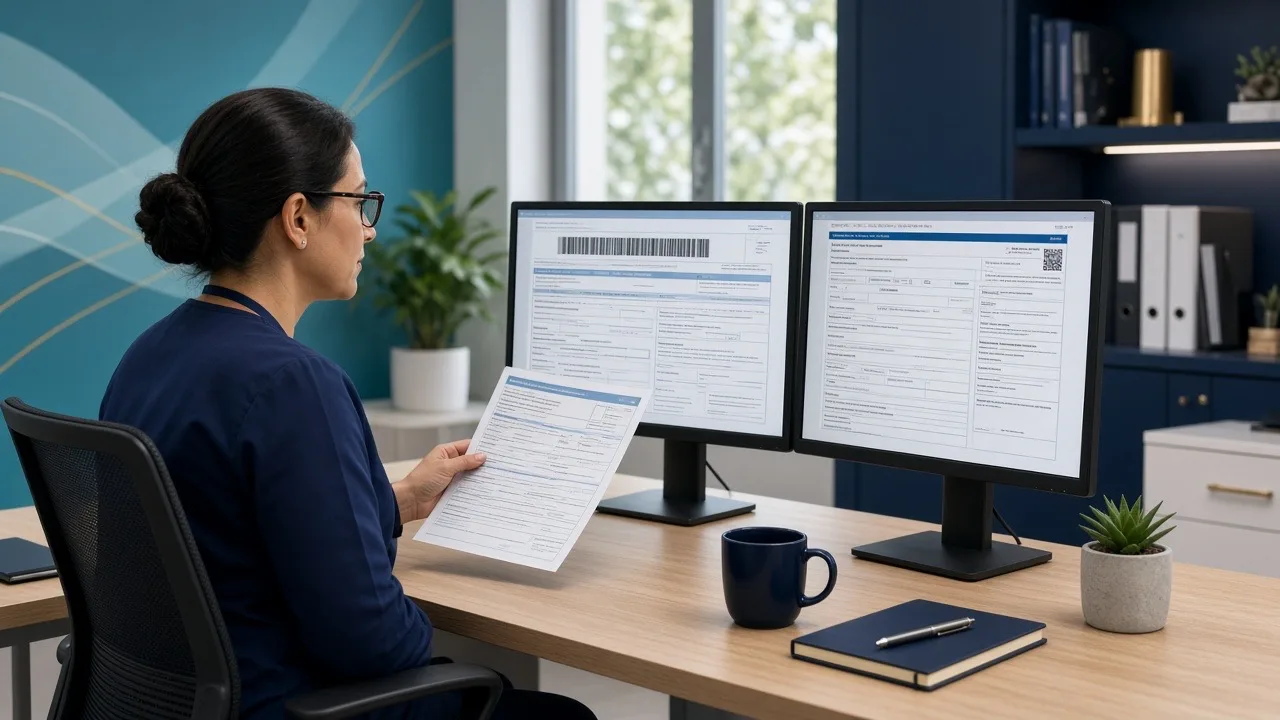
Filing the wrong claim form does not look like a coding problem — it looks like a claim that never should have been built that way.
CMS-1500 vs UB-04 is one of the highest-searched topics in medical billing because billers, practice managers, and new specialty programs need a fast answer: which form do we use, and what breaks if we guess? The choice is rarely optional. It follows provider type, billing entity, and whether the claim is professional or institutional.
This guide explains CMS-1500 vs UB-04 in plain language, when to use each form (and their electronic equivalents), common mistakes that trigger rejections, and a checklist to keep first-pass claims clean.
Quick Answer
Use CMS-1500 (837P) for professional / non-institutional claims — physicians, APPs, therapists, and similar providers billing professional services.
Use UB-04 / CMS-1450 (837I) for institutional / facility claims — hospitals, SNFs, home health, hospice, and many facility-based programs.
A clean workflow should:
- Confirm billing entity and enrollment before claim build
- Match claim type to contract and place of service
- Use CMS-1500 fields for professional logic (POS, diagnosis pointers, rendering NPI)
- Use UB-04 logic for institutional data (type of bill, revenue codes, statement dates)
- Never force facility episodes onto a CMS-1500 just because “that is what our biller knows”
- Scrub claim-type errors before clearinghouse submission
- Track rejections by form/route, not only by CPT
Wrong form = wrong adjudication path. Fix the route first.
Need cleaner first-pass claims? Radiant RCM can review your claim routing, scrubbing, and denial patterns. Request a demo or explore our Medical Billing Services.
Table of Contents
- Quick Comparison
- What Is the CMS-1500?
- What Is the UB-04?
- When to Use Each Form
- Common Mistakes That Cause Denials
- Claim Form Checklist
- When Support May Help
- FAQs
CMS-1500 vs UB-04: Quick Comparison
- CMS-1500 / 837P: professional claim for non-institutional providers
- UB-04 (CMS-1450) / 837I: institutional claim for facility providers
- Key CMS-1500 controls: place of service, diagnosis pointers, modifiers, rendering provider
- Key UB-04 controls: type of bill, revenue codes, statement/admission dates, discharge status
- Paper vs electronic: paper forms explain the data model; most claims transmit as 837P or 837I
This decision connects to clearinghouse routing, place of service codes, claim scrubbing, and rejection vs denial handling.
What Is the CMS-1500 Form?
The CMS-1500 (formerly HCFA-1500) is the standard professional claim form used by non-institutional providers. Electronically, the same data travels as an 837P transaction.
Use it when billing professional services such as:
- Physician and APP office or outpatient professional services
- Therapy and many behavioral health clinician professional claims
- Other non-institutional professional or supplier claims when payer rules require 837P
High-risk CMS-1500 fields include Box 24B place of service, diagnosis pointers, modifiers, units, and rendering NPI. Related guides: modifier usage and clean claim rate.
What Is the UB-04 Form?
The UB-04 (CMS-1450) is the standard institutional claim form. Electronically, it maps to the 837I transaction.
Use it when billing facility / institutional services such as:
- Hospital inpatient and outpatient facility claims
- Skilled nursing, home health, hospice, and similar institutional settings
- Many program/facility episodes (for example, some PHP/IOP or residential models) when the contract and enrollment are institutional
UB-04 claims hinge on type of bill, revenue codes, statement dates, admission data, and discharge status. There is no CMS-1500-style place of service field on UB-04 — using POS thinking on an institutional claim is a common training error.
When to Use CMS-1500 vs UB-04
Choose CMS-1500 / 837P when:
- The billing provider is a professional / non-institutional entity
- You are billing clinician professional services
- Payer enrollment and contracts expect professional claims
Choose UB-04 / 837I when:
- The billing provider is an institutional / facility entity
- You are billing facility room, board, revenue-code-driven services, or institutional episodes
- Payer contracts and enrollment expect institutional claims
Watch for hybrid operations
A practice can generate both claim types across service lines. Example: outpatient clinician therapy on CMS-1500, while a facility-based program bills institutional charges on UB-04. Reusing one template for both creates silent routing failures.
Also confirm credentialing vs payer enrollment for each billing entity before go-live.
Common CMS-1500 vs UB-04 Mistakes That Cause Denials
1. Forcing facility episodes onto CMS-1500
Teams often do this because professional billing is familiar. Result: wrong claim type, wrong required fields, and early rejections.
2. Missing institutional controls on UB-04
Type of bill, revenue code/HCPCS pairing, statement dates, and discharge status must agree. One mismatch can stop the claim before clinical review starts.
3. Broken CMS-1500 diagnosis pointer logic
Each service line must point to supporting diagnoses. Pointer errors create information denials and medical-necessity friction. See medical necessity.
4. Ignoring clearinghouse claim-type routing
If the clearinghouse expects 837I and receives 837P data (or the reverse), the failure may look like a “missing field” problem when the real issue is route selection. Related: CARC codes.
5. Corrected-claim mistakes after the wrong form was used
Resubmitting the same wrong claim type as “new” creates duplicates. Use corrected-claim rules and confirm original claim identifiers. See duplicate claims.
Seeing claim-type rejections every week? Book a Radiant RCM demo to tighten form selection, scrubbing, and first-pass acceptance.
CMS-1500 vs UB-04 Checklist
- Confirm billing entity (professional vs institutional)
- Confirm payer enrollment supports that claim type
- Select CMS-1500/837P or UB-04/837I before coding the claim
- For CMS-1500: validate POS, pointers, modifiers, rendering NPI
- For UB-04: validate type of bill, revenue codes, statement/admission dates, discharge status
- Scrub claim-type edits before clearinghouse submission
- Review acceptance/rejection reports the same day
- Track top failures by claim form and payer
- Train staff that POS belongs on professional claims — not as a UB-04 substitute
- Escalate recurring route errors to enrollment/contract review
This checklist supports stronger clean claim rate and lower cost to collect by cutting rework.
When Outside Support May Help
Your organization may need help when:
- Programs expanded from outpatient to facility care without a new claim-type playbook
- Clearinghouse rejects cluster around claim type or bill type
- Staff mix CMS-1500 and UB-04 fields in one workflow
- Clean claim rate falls after a new service line launches
- Enrollment and billing templates disagree on professional vs institutional routing
Radiant RCM supports healthcare practices with medical billing, claim scrubbing, denial prevention, and revenue cycle consulting.
Sensitive patient and insurance information should only be shared through approved and secure channels. Learn more about Radiant RCM's HIPAA compliance and information-handling approach.
Final Thoughts
CMS-1500 vs UB-04 is not a preference contest. It is a routing decision that determines required data, payer edits, and payment path. Choose the form by billing entity and service type, scrub the right fields, and fix route errors before they age into A/R.
If claim-form confusion is creating rejections and rework, Radiant RCM can help. Request a demo to see how our billing workflows keep professional and institutional claims on the right path.
Frequently Asked Questions
What is the difference between CMS-1500 and UB-04?
CMS-1500 is the professional claim form (electronic 837P). UB-04 is the institutional claim form (electronic 837I). They collect different required data and follow different payer adjudication paths.
Is UB-04 the same as CMS-1450?
Yes. UB-04 is the common name for the CMS-1450 institutional claim form.
Do electronic claims still use CMS-1500 and UB-04?
Most claims transmit electronically as 837P or 837I, but the paper forms remain the reference model for required data elements and troubleshooting.
Which form should a physician practice use?
Most physician and APP professional services bill on CMS-1500 / 837P. Facility charges under an institutional provider generally use UB-04 / 837I.
Can one organization bill both forms?
Yes. Multi-entity or multi-program organizations often bill both. Each service line needs the correct enrollment, template, and scrubbing rules.
What happens if you use the wrong claim form?
Claims are often rejected or delayed because required fields, code sets, and payer edits do not match the expected claim type. Rework rises and clean claim rate falls.
Privacy Notice: Please do not submit patient records, insurance information, medical details, claim files, or other protected health information through the public website form. Review the Radiant RCM Privacy Policy before submitting an inquiry.
This article provides general operational information. Claim form requirements and payer enrollment rules vary. Confirm current CMS, NUCC, NUBC, and payer-specific instructions before changing claim workflows.